
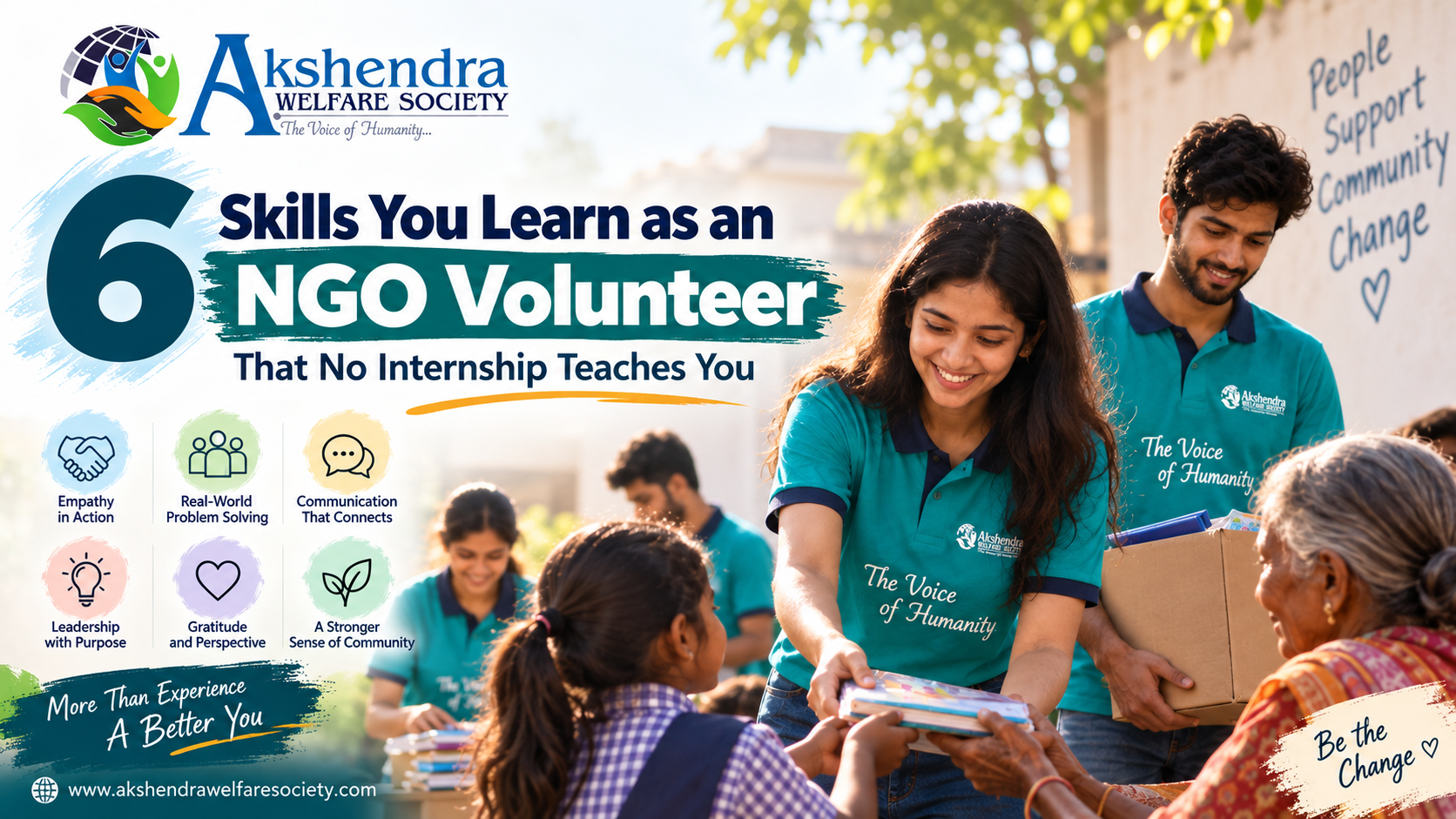
Internships look great on your resume. But volunteering changes who you are.
At Akshendra Welfare Society in Pratap Nagar, Jaipur, we have seen college students and school students walk in as volunteers and walk out as leaders. Internships teach you how to meet deadlines. NGO volunteering teaches you how to meet real people.
1. Real Empathy, Not Textbook Empathy
In an internship, you learn about ‘user personas.’ In an NGO, you sit with a 9-year-old child who dropped out of school because he couldn’t afford notebooks. You learn to listen without judging. At our education drives in Sanganer, our volunteers learn that a child doesn’t need sympathy — they need someone to patiently teach them the alphabet for the 10th time.
2. Resourcefulness – How to Do More With Less
An MNC intern gets software, budget, and a team. An NGO volunteer gets Rs. 500, 3 hours, and 20 children who need food. You learn real Jugaad — how to organize a medical camp with limited medicines, how to teach English without a smartboard. If you can manage a donation drive in Jaipur’s 45-degree heat, you can manage any project.
3. Communication That Actually Connects
You will talk to everyone — a daily wage labourer mother, a disabled youth looking for a job, a donor on Instagram. You learn to change your language, not your message. This is the communication that no PPT can teach.
4. Leadership Without a Designation
No one calls you ‘Sir’ here. No one has to listen to you. You have to earn it. When you lead 10 school students on a Sunday clothes donation drive in Pratap Nagar, you learn real leadership — managing people who are there because they believe, not because they are paid.
5. Understanding Ground Reality of Jaipur
You live in Jaipur, but do you know Jaipur? Most of us know C-Scheme and WTP. Volunteering takes you to the Jaipur that doesn’t come on Instagram — the slums behind Sanganer, the families near Muhana Mandi. You understand poverty not from news, but from the lane next to your house.
6. A Sense of Purpose
Internships end with a certificate. Volunteering ends with a thank you that you never forget. When a disabled youth you trained gets his first job, you learn why you work in the first place. This sense of purpose keeps you mentally strong.
“I came for a certificate for my college application. I stayed because for the first time, my work actually mattered to someone.” — Anjali, Volunteer from Jagatpura, Jaipur